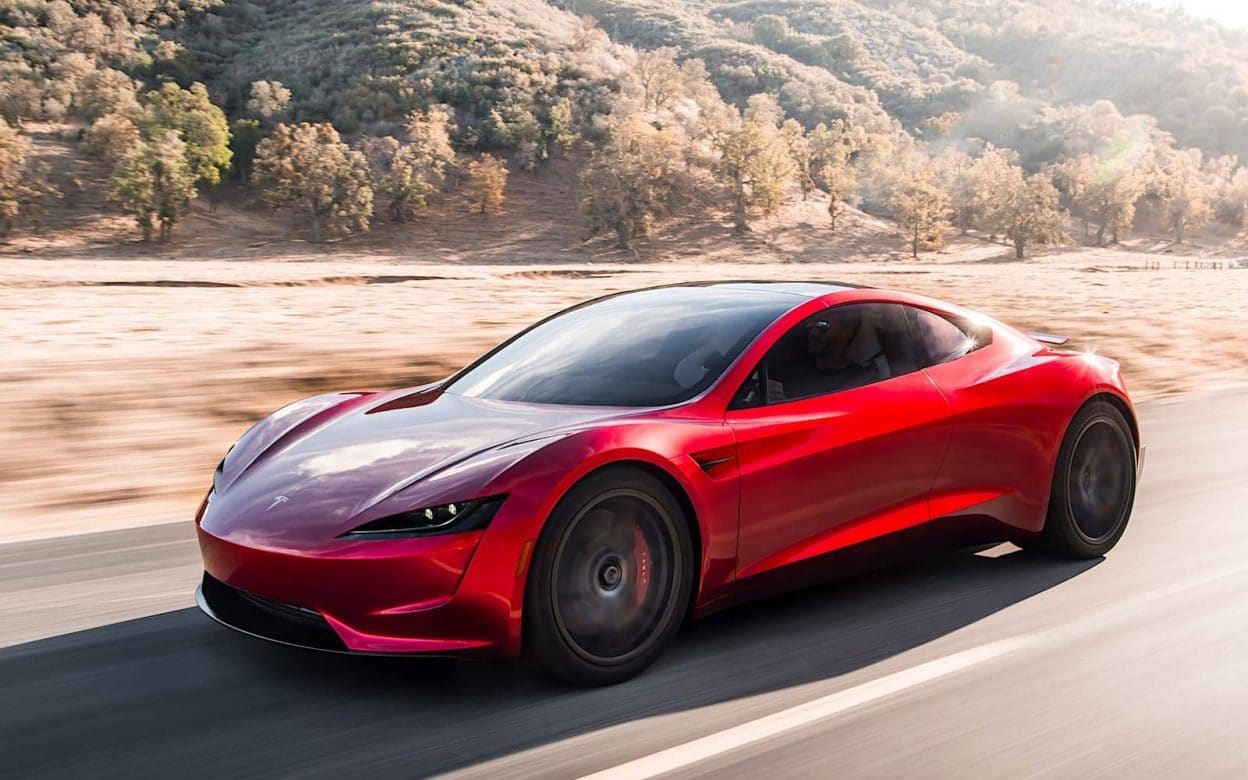

On October 15, 2026, Elon Musk hosted a livestreamed event at SpaceX‘s rocket development and testing facility in McGregor, Texas (near Waco), and unveiled the next-generation Tesla Roadster. The demonstration showed a prototype performing aerial flips, jumps, and upside-down driving using SpaceX-derived cold-gas thrusters and a multi-mode suction system. Musk immediately posted on X: “Turns out the future does have flying cars.”
The car was operated remotely during the demo “to make sure we don’t kill anyone.” Musk described the vehicle as the result of “what happens when you have a collaboration with the world’s best car company and the world’s best rocket company.”
The Demonstration
The prototype executed several high-profile stunts:
- It drove up a large curved ramp and used its suction system to grip the surface while fully inverted.
- It launched off the ramp, completed mid-air flips and rolls using thrusters, and landed on its wheels.
- It leaped over a line of parked Tesla vehicles (including a Tesla Semi in some footage) with assistance from the thrusters.
- In a separate acceleration run, it reached 0–60 mph in 0.81 seconds (with rollout subtraction reported by some outlets as approximately 0.67 seconds).
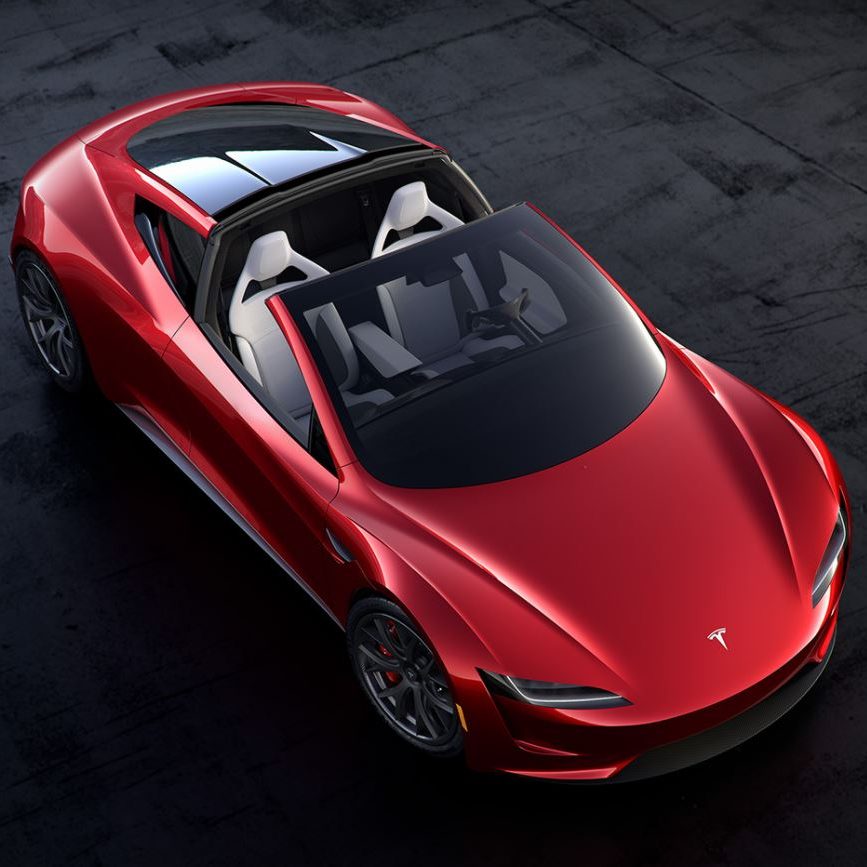
Musk told the audience that success was “not guaranteed” but “it’ll probably work,” and that the event was staged at a safe distance. He also said the car is “not necessarily a safety optimised car but it takes the fun meter to 11.”
Technology: Cold-Gas Thrusters and Suction System
The flight and extreme performance capabilities come from a SpaceX collaboration. The system uses ultra-high-pressure compressed air stored in carbon-overwrapped pressure vessels (COPVs), not traditional rocket fuel. Reports indicate approximately 600 liters of air capacity feeding multiple nozzles (up to 10 in the highest configuration).
Key elements include:
- Rear main thrusters for forward acceleration and short hops.
- Additional altitude-control and perimeter thrusters (especially on the Rocket variant) that enable rolls, lateral movement, and controlled landings.
- A multi-mode suction system that generates enough downforce for the car to drive or hang upside down.
Tesla and Musk have described the thrusters as capable of delivering force several times greater than the tires alone. The air tanks can be recharged, so no special propellant is required. Engineering Vice President Lars Moravy noted that the combination of thrusters and weight reduction enables the extreme acceleration figures.
Tesla Roadster 2026 Variants
Tesla outlined three primary configurations:
Performance (Road Ready)
Two-seater. Active aerodynamics and multi-mode suction system. Claimed 0–60 mph under 1.6 seconds. Reservations open with a roughly $50,000 deposit. Intended as the more conventional road-going version.
Thrust (Race Ready)
Two-seater. Adds rear-mounted cold-gas thrusters. Claimed 0–60 mph under 0.9 seconds. Limited release. Higher reservation deposit (reports of approximately $250,000). Positioned for track-focused performance.
Rocket (Air Ready)
Single-seater, invite-only. Full perimeter thruster array for upward, forward, and rotational movement. Claimed 0–60 mph under 0.59 seconds and top speed over 230 mph. Tesla has explicitly stated this version is not approved for public road use and features a “full flight system.”
Across versions, Tesla lists more than 300 miles of range (some detailed reports cite 310–320 miles). Higher-output trims are associated with power figures exceeding 1,000 horsepower (reports of roughly 1,341 hp in top configurations). Top speed targets exceed 230 mph, with Musk suggesting longer-term ambitions closer to half the speed of sound. Production is targeted for 2028 at facilities including Giga Texas.
Key Quotes from Elon Musk
- “Turns out the future does have flying cars.”
- “Flying cars are real. It’s got altitude controls, thrusters and main thrusters in the rear. So it can basically fly like a rocket, it can do rolls, crazy gymnastics.”
- “I’m not sure it’s necessarily legal in all jurisdictions.”
- The prototype is “not necessarily a safety optimised car but it takes the fun meter to 11.”
- “Success is not guaranteed… It’ll probably work, but if it doesn’t work, we’re at a safe distance. Excitement is 100 percent guaranteed.”
- He described the technology as the outcome of combining the world’s best car company with the world’s best rocket company.
Regulatory, Safety, and Expert Context
Aviation experts and regulators have emphasized practical limits. The demonstration showed short hops and controlled jumps rather than sustained flight. The Federal Aviation Administration (FAA) has jurisdiction over any machine that leaves the surface of the Earth. Vehicles above certain weight thresholds typically require certification that can take years, and operators may need aviation credentials beyond a standard driver’s license. Most jurisdictions restrict aircraft takeoffs and landings from public roads.
Tesla has stated that flying the vehicle is not permitted on public roads. The Rocket variant is invite-only and not approved for public road use. Musk himself acknowledged legal and safety caveats during the event.
Additional expert notes include concerns about the inherent trade-off between the weight required for a safe road car and the low weight preferred for flight, as well as the engineering difficulty of stable transition between ground and air.
Background and Timeline
Tesla first revealed the next-generation Roadster concept in 2017 and teased a SpaceX thruster package for brief flight capability. The project experienced repeated delays over nearly a decade. Earlier public comments from Musk (including on podcasts) described the technology as “crazier than all the James Bond cars combined” and referenced the long-standing observation that “we wanted flying cars.” The October 2026 event marked the first full public demonstration of the thruster system in action.
Implications and Remaining Questions
The unveiling generated massive attention on X and across major outlets including The Guardian, CNN, CBS, Wired, Newsweek, and others. It positions the Roadster as a halo product that merges automotive and aerospace engineering. At the same time, significant questions remain around final pricing (beyond deposits), real-world range and performance validation, production timeline adherence (Musk has a history of delays), safety certification, and whether the thruster capability will ever be usable outside controlled private facilities.
The car represents the most concrete public step yet toward Musk’s long-discussed vision of a thruster-equipped Roadster, while also highlighting the substantial gap between a dramatic demonstration and a street-legal or air-legal production vehicle.
Frequently Asked Questions
What is the Tesla flying Roadster?
It is the next-generation Tesla Roadster revealed in October 2026 that uses SpaceX cold-gas thrusters and a suction system for extreme acceleration and short airborne maneuvers.
When will the Tesla Roadster go into production?
Tesla has targeted production in 2028.
How fast is the Tesla Roadster from 0-60 mph?
The demonstration car achieved 0.81 seconds. Claims range from under 1.6 seconds (Performance) to under 0.59 seconds (Rocket).
Does the Tesla Roadster actually fly?
It can perform short hops, flips, rolls, and jumps using cold-gas thrusters. It is not designed for sustained flight like a conventional aircraft.
What are the Tesla Roadster variants?
Performance (road-ready, two seats), Thrust (race-ready with rear thrusters, two seats), and Rocket (invite-only single-seater with full flight system).
Is the Tesla Roadster legal to fly on public roads?
No. Tesla has stated that flight is not permitted on public roads, and the Rocket variant is not approved for public road use. Significant FAA and local regulatory hurdles remain.
How much does the Tesla Roadster cost?
Full pricing has not been announced. Reservation deposits are approximately $50,000 for the Performance version and $250,000 for the Thrust version. The Rocket is invite-only.
What powers the thrusters?
Ultra-high-pressure compressed air (cold-gas thrusters) stored in onboard tanks, developed in collaboration with SpaceX.






Leave a Reply