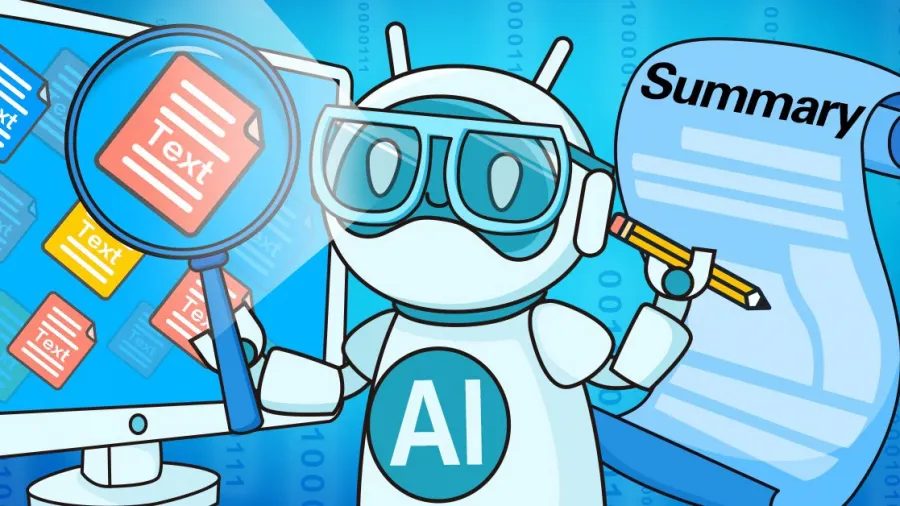

Summarising text means condensing long content into a shorter version that keeps the main ideas and key points. Whether you are a student, professional, or researcher, the ability to create clear summaries saves time and improves understanding.
This guide explains proven summarisation methods, free and AI-powered tools, and practical techniques for producing high-quality summaries. It also covers related needs expressed in searches such as “สรุป.”
Quick answer: To summarise text effectively, read the whole piece, identify the main idea and the key supporting points, remove examples and repetition, then rewrite the essentials in your own words at a fraction of the original length, often around 10 to 25 percent. AI tools can produce summaries quickly, but you should always check them against the original for accuracy and missing points.
What Is Text Summarisation?
Text summarisation is the process of reducing a longer piece of writing while preserving its core meaning. A good summary is significantly shorter than the original but still conveys the essential information, arguments, and conclusions.
Summaries are used for:
- Study notes
- Meeting recaps
- Research overviews
- Content repurposing
- Quick decision-making
Types of Summarisation
Extractive Summarisation
Selects and combines the most important sentences directly from the original text.
Abstractive Summarisation
Rewrites the content in new words while keeping the meaning. Modern AI tools often use this approach.
Hybrid Summarisation
Combines both methods for better accuracy and readability.
Manual Methods to Summarise Text

- Read the full text carefully.
- Identify the main idea and supporting points.
- Highlight or note key sentences.
- Remove examples, repetition, and minor details.
- Rewrite the essential points in your own words.
- Check that the summary stands alone and makes sense.
Best Free and AI Tools for Summarisation
AI Writing Assistants
Tools such as ChatGPT, Claude, and similar models can generate clear summaries when given a well-written prompt.
Browser Extensions
Several extensions summarise web articles with one click.
Dedicated Summarizer Websites
Free online tools accept pasted text or URLs and return condensed versions.
Note-Taking Apps
Some apps include built-in summarisation features for documents and meetings.
How to Get Better Summaries from AI Tools
- Specify the desired length (for example, “in 5 bullet points” or “under 150 words”)
- Ask for a particular format (bullets, paragraph, or executive summary)
- Request focus on specific aspects if needed
- Provide context about the audience
- Always review and edit the output
Common Mistakes in Summarisation
- Including too many minor details
- Changing the original meaning
- Making the summary almost as long as the source
- Omitting critical conclusions or data
- Copying large sections without condensing
- Failing to check accuracy
Practical Uses of Summarisation
Students
Create study notes and chapter summaries.
Professionals
Produce meeting minutes, report overviews, and email digests.
Researchers
Quickly review multiple papers or articles.
Content Creators
Repurpose long content into social posts or newsletters.
Summary vs Paraphrase vs Synopsis vs Abstract
| Term | What it means | Length |
|---|---|---|
| Summary | The main points of a text in your own words | Much shorter than the original |
| Paraphrase | One passage rewritten in your own words | Similar length to the original passage |
| Synopsis | An overview of the plot or structure of a book, film or script | Short, story-focused |
| Abstract | A formal summary at the start of a research paper | Usually one paragraph |
| Executive summary | A summary of a report written for decision-makers | One page or less |
Knowing which one you need helps you choose the right length, tone and level of detail.
Proven Techniques for Summarising
The 5 Ws and H method
Ask who, what, when, where, why and how. The answers form the skeleton of a summary, which is especially useful for news articles and reports.
The one-sentence test
Before writing, try to state the main idea in a single sentence. If you cannot, read the text again. This sentence often becomes the first line of your summary.
Paragraph mapping
Write a few words in the margin next to each paragraph describing its purpose. Then group related notes and write one sentence for each group.
Somebody, Wanted, But, So, Then
For stories and case studies, describe who the main character was, what they wanted, what got in the way, what they did and how it ended.
Reverse outline
For long documents, list the headings and the main point under each. This gives a structured summary that follows the original’s logic.
How Long Should Different Summaries Be?
| Source | Suggested summary |
|---|---|
| News article | Two to four sentences |
| Blog post or essay | One short paragraph or five bullet points |
| Research paper | One paragraph covering aim, method, results and conclusion |
| Business report | Executive summary of up to one page |
| Book chapter | One to three paragraphs |
| Meeting transcript | Decisions, action points with owners and deadlines, open questions |
The right length always depends on your reader and purpose, so these are starting points rather than rules.
Example: Summarising a Short Passage
Original (about 90 words):
Remote work has changed how many companies operate. Employees often report saving time on commuting and having more flexibility to manage personal responsibilities. However, some managers worry about collaboration, mentoring for junior staff and maintaining company culture. As a result, many organisations now use hybrid arrangements, asking staff to come into the office on certain days while allowing remote work on others. Companies that communicate clearly about expectations and provide good digital tools tend to find hybrid work easier to manage.
Summary (about 35 words):
Remote work offers employees flexibility and time savings but raises concerns about collaboration and culture. Many organisations now use hybrid models, which work best with clear expectations and good digital tools.
Notice that the summary keeps the main idea, the key benefit, the key concern and the outcome, while dropping minor details.
AI Prompt Templates for Summaries
Copy and adapt these prompts for tools such as ChatGPT, Gemini or Claude:
- “Summarise the text below in five bullet points for a busy manager. Include any numbers, deadlines and decisions.”
- “Write a 100-word summary of this article for secondary school students.”
- “Create an executive summary of this report with sections for key findings, risks and recommendations.”
- “Summarise this meeting transcript into decisions, action items with owners and open questions.”
- “Give me a one-sentence summary, then a one-paragraph summary, of this research paper.”
- “Summarise this text, then list anything important you left out.”
How to Check an AI Summary for Accuracy
- Compare against the original. Make sure each point in the summary actually appears in the source.
- Check numbers, names and dates, which AI tools sometimes change or invent.
- Look for missing caveats. Summaries can drop important conditions such as “in some cases” or “in early tests”.
- Watch for added opinions that the original author did not express.
- Ask the tool to quote its sources within the text, so you can find each point quickly.
Summarising Different Types of Content
Academic papers: focus on the research question, method, main findings and limitations. Read the abstract, introduction and conclusion first, then check the results section for details.
Books: summarise chapter by chapter, then combine those notes into an overall summary of the main arguments or story.
Videos and podcasts: use a transcript if available, then summarise it like any other text, adding timestamps for important sections.
Emails and long threads: highlight what was decided, what is still open and what you need to do next.
Legal or technical documents: summaries help understanding, but always rely on the full original, or a qualified professional, for decisions.
Expert Tips for Better Summaries

- Write the summary without looking at the original first, then check it. This forces genuine understanding.
- Use the author’s key terms but your own sentence structure.
- Keep your opinion out of a summary unless you are asked to evaluate the text.
- Cite the original source when you share a summary in academic or professional work.
- Put the most important point first, as many readers only read the opening line.
Key Takeaways
- Effective summarisation keeps main ideas while significantly reducing length.
- Both manual techniques and AI tools can produce good results.
- Clear instructions improve AI-generated summaries.
- Always review summaries for accuracy and completeness.
- Different situations call for different summary lengths and styles.
- Choose the right format, such as a summary, abstract or executive summary, for your reader and purpose.
- Always check AI summaries for accuracy, missing caveats and invented details.
Frequently Asked Questions
What is the best way to summarise a long article?
Read it fully, identify the core argument and key supporting points, then rewrite those elements concisely in your own words or with AI assistance.
Are AI summarizers accurate?
They are generally good for capturing main ideas, but they can miss nuance or occasionally alter meaning. Human review is recommended.
How long should a summary be?
It depends on the purpose. A common target is 10 to 25% of the original length, or a fixed format such as 5 to 7 bullet points.
Can I summarise copyrighted text?
Creating a short summary for personal study or fair use commentary is usually acceptable. Republishing large portions is not.
What is the 10 percent rule for summaries?
A common guideline is that a summary should be around 10 to 25 percent of the original text’s length, though there is no fixed rule. A 1,000-word article might become a summary of 100 to 250 words. Always adjust the length to your purpose and your reader’s needs.
How do I summarise a text without plagiarising?
Read the text, close it and write the main points in your own words and sentence structure. Use quotation marks for any exact phrases you keep, and cite the original source. Then compare your summary with the original to make sure you have not copied sentences too closely.
Can AI summarise PDFs and long documents?
Yes. Many AI assistants, including ChatGPT, Gemini and Claude, can summarise uploaded PDFs and long documents. For very long files, ask for a section-by-section summary first, then an overall summary. Always check important figures and conclusions against the original document before relying on them.
What should a meeting summary include?
A useful meeting summary includes the date and attendees, the main topics discussed, decisions made, action points with owners and deadlines, and any open questions. Keep it short and share it soon after the meeting, so everyone has a clear record while the discussion is still fresh.





Leave a Reply