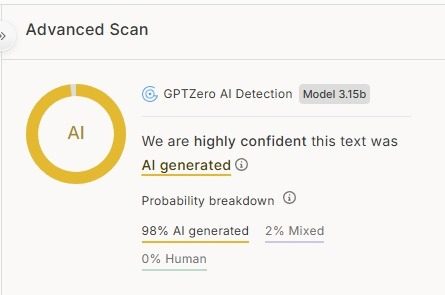

Checking whether text was written by AI has become important for teachers, editors, content managers, and businesses. AI detection tools analyze writing patterns to estimate the likelihood that content was generated by models such as ChatGPT or similar systems.
This guide explains how AI text detection works, the best available methods, their accuracy limitations, and practical tips for checking content.
Quick answer: To check whether text is written by AI, run it through two or more AI detection tools, then review it manually for signs such as generic phrasing, missing personal detail, unsupported facts, and an unusually even style. Compare it with the author’s earlier writing and, where possible, look at drafts or version history. Treat any detector score as a probability, not proof, and never rely on one tool alone.
What Is AI Text Detection?
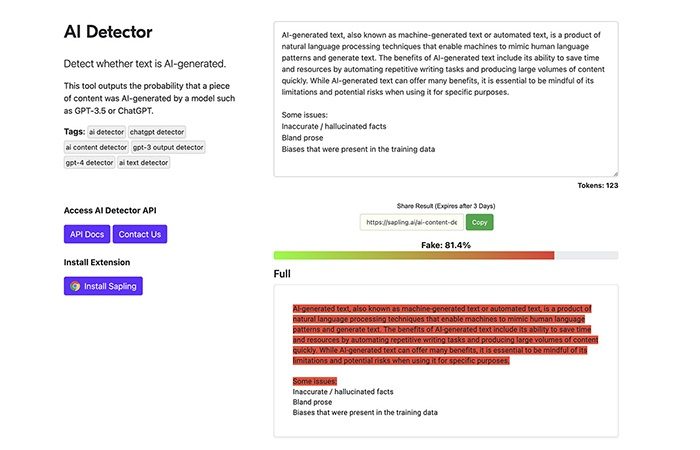
AI text detection is the process of analyzing written content to determine whether it was likely produced by an artificial intelligence model. Detection tools look for statistical patterns, predictability, and stylistic features that differ from typical human writing.
Searches such as “перевірка на ші” (AI check) reflect growing demand for these tools in different languages.
How AI Detection Tools Work
Most detectors examine:
- Sentence structure and predictability
- Word choice patterns
- Repetition and consistency
- Burstiness (variation in sentence length)
- Comparison against known AI-generated text patterns
The tool then provides a probability score or classification.
Common Ways to Check for AI-Generated Text
1. Online AI Detection Tools
Websites where you paste text and receive an AI probability score.
2. Built-in Platform Detectors
Some writing and educational platforms include AI detection features.
3. Manual Review
Experienced readers can sometimes identify overly uniform tone, lack of personal detail, or generic phrasing.
4. Combined Approach
Using both automated tools and human judgment usually produces more reliable results.
Limitations of AI Detection
- No detector is 100% accurate
- Human writing can sometimes be flagged as AI
- AI-generated text can be edited to avoid detection
- Short texts are harder to analyze reliably
- Results vary between different detection tools
- New AI models can reduce detection effectiveness
Tips for More Reliable AI Checks
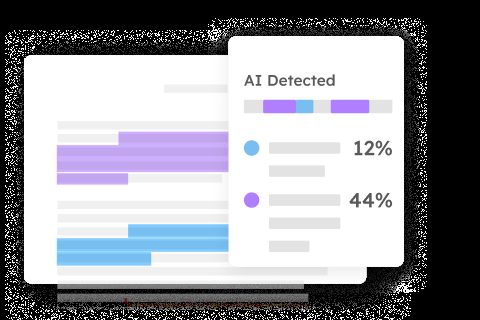
- Test the same text on more than one detector
- Review longer passages rather than single sentences
- Look for personal examples, specific details, and natural variation
- Consider the context and source of the writing
- Use detection as one signal, not the only evidence
- Stay updated as both AI writing and detection tools evolve
Best Practices for Different Users
Teachers and Educators
Combine detection tools with discussions about the student’s work and writing process.
Content Managers
Use detectors as a first filter, then apply editorial review.
Businesses
Establish clear policies on AI use and verify important content manually.
Key Terms Explained
- AI-generated text: writing produced fully or partly by a large language model such as ChatGPT, Gemini, or Claude.
- AI detector: software that estimates how likely it is that text was generated by AI.
- Perplexity: a measure of how predictable text is to a language model. AI text often has lower perplexity because models tend to choose likely words.
- Burstiness: variation in sentence length and structure. Human writing often mixes short and long sentences more unevenly.
- False positive: human writing incorrectly flagged as AI.
- False negative: AI writing that passes as human.
- Watermarking: a hidden statistical signal some AI providers can add to generated text so it can be identified later. Google’s SynthID is one example of this approach.
Signs of AI-Generated Text to Look for Manually
No single sign proves anything, but several together are worth investigating:
- Generic, safe statements that could apply to almost any topic
- Lack of personal experience, specific examples, or original opinions
- Repetitive structure, such as every paragraph following the same pattern
- Overused transition phrases and tidy summaries at the end of every section
- Confident but incorrect facts, invented sources, or references that cannot be found
- Mismatched knowledge, such as a sudden jump in vocabulary or style compared with the writer’s usual work
- Answers that miss the exact brief but cover the general topic well
Step-by-Step: How to Check a Text for AI
- Read the full text first and note anything that feels generic, inconsistent, or factually doubtful.
- Run it through at least two detectors. Different tools use different models, so compare their results.
- Check longer passages. Detectors are less reliable on short texts, so test whole paragraphs or the full document.
- Verify facts and sources. Look up quotes, statistics, and references. Invented citations are a strong warning sign.
- Compare with known writing by the same person, such as earlier essays, emails, or reports.
- Look at the writing process. Version history in Google Docs or Microsoft Word, drafts, and notes show how a text developed.
- Talk to the author. Asking someone to explain their argument, sources, or choices often clarifies the situation quickly.
- Record your reasoning if a decision matters, rather than relying on a screenshot of a score.
Comparing Detection Approaches
| Approach | Strengths | Weaknesses |
|---|---|---|
| Free online detectors | Quick, easy, no account needed | Results vary, text limits, privacy concerns |
| Paid or institutional detectors | Integrated with learning or publishing platforms, reports | Still produce false positives and negatives |
| Manual review | Considers context, facts, and the writer | Time-consuming, subjective |
| Writing process evidence | Strong evidence of how work was created | Needs drafts or version history to be available |
| Conversation with the author | Clarifies understanding and intent | Requires time and a fair, open approach |
Why AI Detectors Make Mistakes
AI detection is difficult for several reasons:
- Language models keep improving, producing text that is more varied and natural.
- Editing changes the signal. When people rewrite AI drafts, or use AI to polish their own writing, the text becomes a mix that tools struggle to classify.
- Formal and simple writing can look predictable. Technical writing, legal text, and writing by people using a second language may be flagged unfairly. Researchers at Stanford University published a study in 2023 suggesting that GPT detectors were more likely to misclassify writing by non-native English speakers.
- Short texts give too little evidence for a reliable judgement.
- Even AI companies have found it hard. OpenAI withdrew its own AI text classifier in 2023, citing its low rate of accuracy.
What to Do If a Detector Flags Your Writing
If you wrote something yourself and a tool flags it as AI:
- Stay calm. A detection score is not proof.
- Gather evidence of your process, such as drafts, notes, research history, and version history.
- Explain how you wrote the piece and be ready to discuss it.
- Ask which tool was used and what score it gave.
- Refer to your institution’s or employer’s policy on AI and on appeals.
Ethical Use of AI Detection
AI detection affects people’s grades, jobs, and reputations, so use it responsibly:
- Be transparent about when and how detection is used.
- Use results as a starting point for a conversation, never as the sole basis for a penalty.
- Protect privacy by checking how a tool stores the text you upload, especially for student work or confidential documents.
- Set clear rules about acceptable AI use, so people know what is allowed before they write.
AI Detection and SEO Content
For publishers and businesses, the bigger question is usually quality rather than origin. Google’s guidance on AI-generated content focuses on whether content is helpful, original, and created for people rather than to manipulate search rankings. Editors should check facts, add first-hand experience, and make sure content meets readers’ needs, whether or not AI was involved.
Example: Reviewing a Suspicious Essay
Imagine a teacher receives an essay that feels very different from a student’s usual work. A fair review might look like this:
- The teacher notices polished but general arguments and two references that cannot be found.
- Two detectors give different results, one high and one moderate.
- The teacher compares the essay with the student’s earlier in-class writing and sees a clear change in style.
- The teacher asks the student to talk through the essay’s main argument and explain where the references came from.
- Based on the whole picture, not just the scores, the teacher follows the school’s policy.
This approach protects honest students while still taking possible misuse seriously.
Key Takeaways
- AI detection tools estimate the likelihood that text was generated by AI.
- No tool is perfectly accurate.
- Combining automated checks with human review works best.
- Short or heavily edited text is more difficult to classify.
- Detection technology continues to change as AI models improve.
- Combine detectors with manual review, fact-checking, and evidence of the writing process.
- Detectors can unfairly flag formal writing and second-language writers, so treat scores as probabilities.
Related Guides
- LLM Leaderboard: Complete Guide to Ranking Large Language Models
- Artificial Analysis: What It Means and How It Is Used
- LLM Leaderboard Explained: How AI Models Are Ranked and Compared
Frequently Asked Questions
Can AI detectors accurately identify ChatGPT text?
They can often detect typical AI patterns, but accuracy is not perfect and edited text is harder to identify.
Are free AI detection tools reliable?
Free tools can provide a useful indication, but paid or multiple tools usually give more consistent results.
Can human writing be flagged as AI?
Yes. Formal, uniform, or non-native writing is sometimes incorrectly flagged.
What is the best way to check for AI content?
Use more than one detection tool and combine the results with careful human review.
Can teachers tell if you used ChatGPT?
Teachers may use AI detection tools, compare work with a student’s earlier writing, check sources, and ask students to explain their work. None of these is perfect on its own, but together they can reveal inconsistencies. Clear policies on acceptable AI use help students and teachers avoid misunderstandings.
Why was my own writing flagged as AI?
Detectors look for predictable patterns, so clear, formal, or simple writing can be flagged even when a person wrote it. Writers using a second language may be affected more often. Keep drafts and version history, and explain your writing process if a score is questioned.
Do AI detectors work for languages other than English?
Many detectors support several languages, but accuracy is often best in English, where tools have the most training data. For text in Ukrainian, German, or other languages, check that the tool officially supports the language, test it on known examples, and rely more heavily on manual review.
Can AI-generated text be detected after editing?
Detection becomes harder after significant editing, paraphrasing, or mixing AI text with human writing. Light edits may still be detected, while heavily rewritten text often is not. This is why process evidence, fact-checking, and conversation with the author are more reliable than a detector score alone.





Leave a Reply