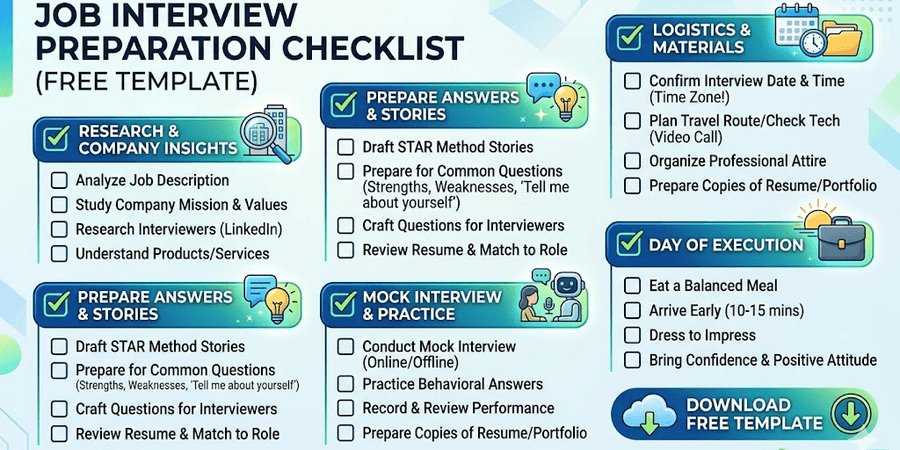

An interview template is a structured document or format used to plan and conduct interviews consistently. It helps interviewers ask relevant questions, evaluate candidates fairly, and keep notes organized. Templates are widely used in hiring, research, journalism, and performance reviews.
This guide explains what an interview template is, why it is useful, the key sections it should contain, different types of templates, and practical examples you can adapt.
What Is an Interview Template?
An interview template is a pre-designed structure that outlines the flow of an interview. It typically includes the questions to be asked, space for notes, evaluation criteria, and sometimes scoring guidelines. Using a template reduces the chance of forgetting important topics and makes it easier to compare responses across multiple candidates or participants.
Common users of interview templates include:
- Hiring managers and recruiters
- Researchers conducting qualitative studies
- Journalists preparing for interviews
- Managers conducting performance or exit interviews
Benefits of Using an Interview Template
- Ensures important topics are covered consistently
- Improves fairness when evaluating multiple people
- Saves preparation time
- Helps interviewers stay focused
- Creates a clear record of responses
- Makes it easier to compare candidates or participants later
Templates are especially valuable when several people are involved in the interview process.
Key Sections of a Good Interview Template
A practical interview template usually contains these parts:
- Basic information
Candidate or participant name, date, interviewer name, and role or topic.
- Introduction
Short script or notes for opening the interview and explaining the process.
- Core questions
The main questions organized by topic or competency.
- Follow-up prompts
Suggested probing questions for deeper answers.
- Notes section
Space to record responses during the interview.
- Evaluation criteria
Key factors to assess (for hiring) or themes to track (for research).
- Closing
Notes for ending the interview and explaining next steps.
Types of Interview Templates
Hiring Interview Template
Focuses on skills, experience, behavioral questions, and cultural fit. Often includes a scoring system.
Research Interview Template
Used in qualitative studies. Emphasizes open-ended questions and space for detailed notes.
Journalistic Interview Template
Organized around story angles, key facts to confirm, and follow-up questions.
Exit Interview Template
Designed to gather feedback from employees who are leaving an organization.
Performance Review Template
Structures discussion around goals, achievements, and development areas.
Sample Structure for a Hiring Interview Template
Candidate Information
Name: Position: Date: Interviewer:
Opening
- Welcome and introductions
- Brief overview of the role and company
- Explain the interview format
Questions
- Tell me about your relevant experience for this role.
- Describe a time you solved a difficult problem at work.
- How do you prioritize tasks when facing multiple deadlines?
- What interests you about this position?
Evaluation Notes
- Technical or role-specific skills:
- Communication:
- Problem-solving:
- Overall impression:
Closing
- Candidate questions
- Next steps and timeline
Tips for Creating and Using Templates
- Keep questions clear and open-ended where possible
- Align questions with the actual requirements of the role or research goal
- Leave enough space for notes
- Use the same template for all candidates in a hiring process
- Review and update the template after several interviews
- Train interviewers on how to use the template consistently
- Avoid overly rigid templates that prevent natural conversation
Common Mistakes to Avoid
- Using the same generic questions for every role
- Including too many questions for the available time
- Failing to leave space for notes
- Not defining evaluation criteria clearly
- Treating the template as a script that cannot be adapted
- Skipping the introduction or closing sections
Key Takeaways
- An interview template provides structure and consistency for interviews
- It typically includes questions, note space, and evaluation areas
- Different purposes (hiring, research, journalism) require different templates
- Well-designed templates improve fairness and make comparison easier
- Templates should be clear, relevant, and flexible enough for real conversations
Frequently Asked Questions
Should every interviewer use the same template?
For hiring processes, yes. Using the same template helps ensure candidates are evaluated on the same criteria.
Can I modify a template during an interview?
Yes. Templates are guides. Interviewers can ask relevant follow-up questions based on the conversation.
How long should an interview template be?
It should fit the scheduled interview time. Most hiring templates contain 6 to 12 core questions plus space for notes.
Are interview templates only for hiring?
No. They are also used in research, journalism, exit interviews, and performance discussions.






Leave a Reply